

20 Apr Handling Payments to Related Entities / Intercompany Transactions
Written by: Mia Carley
(5-7 minute read)
When valuing a business, it is important for an Appraiser to consider whether the subject company being valued records any payments to related entities or intercompany expenses on the provided financial statements. Such transactions may reflect typical accounting practices to increase tax benefits and overall earnings. Additionally, some of these expenses may not be recorded at fair market rates due to the non-arms-length relationship between the subject company and any related entities. Common situations in which a company may record intercompany expenses/payments to a related entity include, but are not limited to:
- Management Fees/ Consulting Fees being paid to a related entity (similar ownership, a parent entity, a subsidiary, etc.)
- Management Fees/ Consulting Fees being paid to the owner or prior owner
- Two entities with similar ownership are being appraised in a single report
Situation #1 (Management Fees Payments to a Related Entity):
Intercompany expenses or payments to a related entity may include management fees. Management fees may be paid by the subject company to a related entity (or the current owner(s) personally) in exchange for managerial services provided. Alternatively, management fees may represent discretionary payments for which no services were provided.
If a company records management fees/ consulting fees on its financial statements, an Appraiser should ask the following questions:
- Who is this expense being paid to?
- Are there any services being rendered on behalf of this expense?
In the situation that the expense is being paid to a related entity, and no services are being rendered, the Appraiser should further request the following documentation:
- Proof that the expense is being paid to the related entity. This usually comes in the form of general ledgers that are clear enough to note the entity to which the expenses are paid; however, in certain instances a 1099, copies of checks, or another form of proof may be applicable. Without this proof, an Appraiser will be unable to confirm who the management fees are paid to.
- A copy of a Federal Tax Return for the related entity to which management fees were paid. The Appraiser will utilize the Federal Tax Return to verify matching ownership with the subject company, as well as to assess the type of expenses incurred by the related entity. If the entity reports mostly discretionary expenses, such as officer compensation, meals, travel, etc., it is apparent that the fee paid to the entity does not contribute to business operations. Therefore, the full management fees can be added back to the company’s net income.
In certain instances, the management fees paid to a separate entity do reflect services and/or operating payments to cover labor, insurance, etc. Consider that after obtaining the same proof as above, the Federal Tax Returns for the related entity include salaries and wages, cost of goods sold, and insurance payments. It is important for the Appraiser to ask the following questions related to these services:
- Are the transactions at a fair-market rate?
- If the transactions are not at a fair-market rate, what is the fair market expense that a hypothetical buyer would incur?
Based on the answers above, the Appraiser must decide on what portion of the management fees can be added back to net income. If all services are provided at a fair market rate, then the Appraiser can add back the non-operating net income, as shown in the example below, as this is still considered to be earnings for the owner of the subject business:
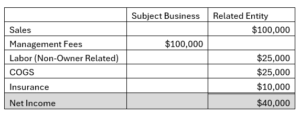
If the expenses are not fair market, then it is necessary for the Appraiser to make a normalizing cash flow adjustment to account for fair-market operating expenses (whether higher or lower), as a hypothetical buyer would be expected to incur expenses at a fair market rate going forward.
Note: If general ledgers and/or Federal Tax Returns are not available, the Appraiser may request a letter that is signed by the company’s CPA which should identify the description of the non-business operating intercompany expenses/payments to a related entity, the amount of expenses/payments recorded in the years being analyzed, and confirm that a hypothetical buyer would not be required to incur the identified expenses in order to maintain current operations. This should be discussed with the client prior to completing the business valuation.
Situation #2 (Management Fees Paid to the Current Owner):
Assuming the same situation as above, and following the same line of questioning, a company could be recording management fees that are stated to represent compensation to the current owner(s). The Appraiser should confirm that the expenses solely reflect compensation to the owner(s). If this is the case, the Appraiser should request documentation in the form of general ledgers, 1099s, or check copies identifying the amounts being paid by the subject company to the current owner in the applicable year, and add this amount back to the company’s net income.
Situation #3 (Intercompany Transaction Elimination):
A multi-entity valuation, in which different entities are treated as a single company for the purpose of the valuation, is a situation in which any intercompany transactions between the entities should be identified on the financial statements provided and removed. As discussed in Situation #3, intercompany transactions may be related to services provided by one entity to the other, including but not limited to the following expenses:
- COGS
- Labor costs
- Equipment leasing
In the context of a multi-entity valuation, it is important that an Appraiser identify and remove any intercompany transactions in order to better analyze and compare ratios, expense margins, earnings multiples, and benchmarks to businesses within the industry.
For this example, an Appraiser is valuing the combined operations of ABC, LLC, a company that does business as a wholesaler, and XYZ, LLC, a separate entity that was created to expand operations in a new territory. These entities will be appraised as if they operate as a single business. Therefore, the Appraiser should ask the following:
- Are there any intercompany transactions between the entities being valued? If so, please identify the revenue or expenses.
The Appraiser confirmed that XYZ, LLC paid $200,000 in cost of goods sold to ABC, LLC in each year of the analyzed period, and these transactions were recorded within XYZ, LLC’s COGS and ABC, LLC’s revenues in each year. Therefore, the Appraiser should remove the intercompany transactions as follows:
- Remove the $200,000 from ABC, LLC’s sales in each year
- Remove $200,000 from XYZ, LLC’s COGS in each year
Conclusion
An important component of the business valuation process is determining whether the company reports any intercompany expenses or payments to related entities. If these expenses exist, the proper documentation and verification should be requested and confirmed in order to most accurately annualize a normalized cash flow for the business.