

17 Apr Key Financial Ratios for Business Valuation
Written by: Philip Acinapuro
(5-7 minute read)
Analyzing financial ratios is crucial to understanding the health of a business and its potential for future growth. Financial ratios can be placed into three main categories: profitability, liquidity, and turnover. In this newsletter, we will discuss seven of the most critical ratios for business valuation and why they are important to analyze.
Profitability Ratios
Operating Profit Margin

In the equation above, EBIT stands for Earnings Before Interest and Taxes. This ratio is a measure of a company’s ability to generate profits from its operations, excluding costs associated with non-operational activities, such as interest and taxes. A higher operating profit margin indicates a more efficient business model, as it shows that the company is able to convert a larger portion of its sales into profit.
Gross Profit Margin

This ratio focuses on the direct costs of producing goods or services, known as the cost of goods sold (COGS), or sometimes as cost of sales. A higher gross profit margin indicates an efficient use of the company’s resources to produce and sell its products.
Liquidity Ratios
Current Ratio
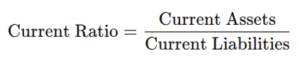
This ratio is a measure of a company’s ability to meet its short-term liabilities using its short-term assets. A ratio greater than 1 indicates that the company has enough assets to cover its liabilities, which is a sign of good liquidity. However, an excessively high current ratio could also suggest that the company is not effectively utilizing its assets, which may cause stagnation in investment-intensive industries. For example, rather than holding excess cash, a manufacturing firm would likely benefit more by using the excess cash to purchase additional machinery to expand production.
Quick Ratio

Also known as the acid-test ratio, the quick ratio is a more stringent measure of liquidity and excludes inventory from current assets, as inventory may not be as easily converted into cash as other assets, such as receivables. A quick ratio of 1 or higher suggests that the company can cover its current liabilities without needing to sell its inventory, while a lower ratio might signal liquidity issues, especially if the business has difficulty converting its inventory into cash quickly.
Turnover
Receivables Turnover

This ratio measures a company’s effectiveness in managing its credit and collections process. A higher ratio means that the company is collecting payments from customers more quickly, which is important for maintaining appropriate levels of cash and preventing bad debts. A low ratio could indicate that the company is taking longer to collect its receivables, which may prevent the company from holding necessary cash.

This ratio measures how long it takes for a company to pay off its suppliers. A lower ratio suggests that the company holds power in relationships with suppliers and can utilize long payment terms, keeping cash within the business for longer periods and suggesting good working capital management. However, if this ratio is too low, it could indicate that the business is overextending payment terms, which could strain supplier relationships or suggest liquidity issues; this could in turn impede a company’s ability to easily acquire inventory in the future.
Inventory Turnover

This ratio assesses how efficiently a company is managing its inventory in relation to its cost of goods sold. A higher ratio indicates that the company is turning over its inventory quickly, which is indicative of efficiency and profitability. A lower ratio could indicate that the company is holding onto inventory for long periods, which may tie up cash and increase storage costs. If a business is holding inventory for too long, it could also lead to outdated inventory or even expired inventory (dependent on the industry) that is unable to be sold.
Days Turnover
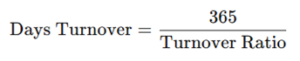
All of the above turnover ratios can also be converted into days turnover by dividing the length of the year in days by the calculated turnover ratio, which provides a more intuitive way of understanding a company’s working capital management. Days turnover provides the average number of days taken to complete one cycle. Receivables days turnover is the average number of days taken to turn a company’s credit sales into cash. Payables days turnover is the average number of days taken to pay suppliers. Inventory days turnover is the average number of days taken to sell and replace all inventory.
Conclusion
These seven key financial ratios provide essential insights into the profitability, liquidity, and operational efficiency of a business. From a valuation perspective, these ratios play a large part in gauging a company’s future earnings capacity. It is therefore vital to analyze these ratios throughout the analyzed period to calculate averages and medians, as well as identify trends. Generally, companies that outperform their industry peers in financial ratios will receive a lower company-specific risk rate and a lower overall discount rate within the income approach, thereby receiving a higher valuation multiple (all else considered equal).