

20 Apr Key Valuation Considerations for Accounts Receivable and Accounts Payable
Written by: Philip Acinapuro, CVA
(4-6 minute read)
When assessing the value of a business, the sales and earnings on the income statement tell only part of the story. Even though a business Appraiser is not engaged or required to complete a full Accounts Receivable or Accounts Payable audit, analysis of Accounts Receivable (A/R) and Accounts Payable (A/P) plays a critical role in determining the company’s true financial health and value.
What are Accounts Receivable and Accounts Payable?
Accounts Receivable (A/R) represent money owed to the business by customers for goods or services already delivered, reflecting revenue that has been recognized but not yet collected in cash. Accounts Payable (A/P), by contrast, represent obligations the business owes to suppliers and vendors, capturing expenses incurred but not yet paid. Together, these accounts directly influence liquidity and overall operational efficiency, which are key valuation considerations.
Cash vs. Accrual Accounting: Why It Matters
In the realm of small businesses, there exist two primary systems of accounting: cash and accrual basis. Under cash basis accounting, revenue and expenses are recognized only when cash is received or paid, meaning A/R and A/P are generally not recorded on the balance sheet (and within sales/expenses on the income statement). Accrual basis accounting, however, recognizes revenue when earned and expenses when incurred, regardless of when cash changes hands. In a valuation context, with all else equal, accrual basis financials are preferred because they provide a more complete financial picture of the company. However, the importance of this consideration varies. For certain industries such as restaurants or retail businesses, cash basis financials may be able to be used as the differences between cash and accrual basis financials are not likely to be material. However, for other industries more reliant on working capital, such as construction and manufacturing, accrual basis financials could be required for sufficient analysis.
If cash basis financials are the only financials available for a transaction with transferring A/R and A/P, the Appraiser must utilize A/R and A/P aging reports to add them to the balance sheet.
Accounts Receivable Analysis
Accounts Receivable must be analyzed because it may not be fully collectable. A key tool in this analysis is the A/R aging report, which categorizes receivables based on how long they have been outstanding. An Appraiser should always request A/R collectability estimates from management, or the individual best suited to answer questions about the company. This is typical in the process of A/R analysis as the business valuation should take into account specific company risks regarding collectability, which may not be easily determined by additional forms of analysis.
An Appraiser will typically divide A/R into two groups: aged under 90 days and over 90 days; older A/R balances generally are less likely to be collected. From there, the Appraiser will utilize the contact’s estimates of collectability, combined with ages of A/R and historical bad debt expenses on the income statement, to adjust A/R to an estimated collectable amount. Finally, the Appraiser should consider the company’s receivable turnover ratios compared to the industry. Below is an example of an Appraiser’s analysis as it relates to A/R collectability.
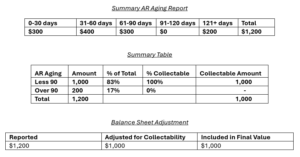
Companies being paid via insurance, such as medical practices, can face particularly high uncollectable accounts risk as claims can be denied or heavily delayed. The following example reflects a sample A/R aging report for a medical practice, along with the adjustments made by the Appraiser. In the response, A/R was stated to be 75% collectable for the under 90 days balance and 53% collectable for the over 90 days balance. The lower collectability for older accounts was associated with lack of payment on insurance claims. Based on these estimates and the balance amounts, the Appraiser included 65% of total A/R in the final value.
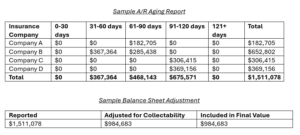
The A/R aging report also allows the Appraiser to analyze the company’s customers/ clients. If any related entities or individual accounts associated with the owner are reported on the A/R aging statement, further analysis may be required.
Accounts Payable Analysis
Similar to A/R, an A/P aging report can be used to evaluate the timing and status of outstanding obligations. Once again, the Appraiser will also review the customer list for any related party transactions. However, for valuation purposes, it is generally assumed that the entire A/P liability will be paid and no adjustment is made for payability.
Conclusion
A/R and A/P analysis is a critical component of business valuations. The inclusion of A/R and A/P in the Final Value must match the structure of the transaction. If A/R and/ or A/P are not included in the transaction, these items will not be included in the Final Value — however, understanding the level of money owed to or from the company is still an important measure of risk assessment.
If you have any questions about this topic, please feel free to reach out – a member of our team will be happy to speak with you!