
19 May The Impact of Equipment Appraisals on Business Valuations
Written by: Ally Yan, CVA
(3-5 minute read)
The conclusion of value in any business valuation includes all operating tangible and intangible assets that will transfer to the buyer. Tangible assets can include working capital plus fixed assets such as furniture, fixtures, equipment, and vehicles, normally carried on the most recent balance sheet at historical cost less the accumulated depreciation (“net book value”). Intangible assets can include goodwill, licenses and customer lists (not an exhaustive list). The combination of these tangible and intangible assets equals the total value of the business.
The allocation of Fixed Assets is determined by one of two ways – either based on the net book value of fixed assets reported on the Company’s balance sheet or through a certified third-party equipment appraisal.
A common misconception is that when both a business valuation and equipment appraisal are completed, the two values are added together for the total value of the company. However, this is not the case. In most situations, only the allocation between tangible and intangible assets is impacted, but not the final value. This is because the value and the earnings multiple already account for this equipment as the company requires the equipment to generate its current level of sales/earnings. Furthermore, the databases utilized within the market approach, and the subsequent multiples calculated typically already include the value of fixed assets. The example below highlights the changes to the allocation of value before and after receiving an equipment appraisal.
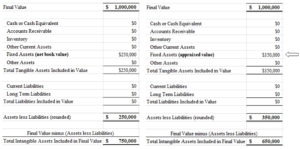
This construction company was appraised at $1,000,000. Only fixed assets and intangible assets are included in the transaction. Therefore, based on the net book value, the value of Fixed Assets is $250,000 and the remaining $750,000 is allocated to intangible assets. Then, an equipment appraisal was ordered by the client, which reflects an appraised value of equipment of $350,000. The appraiser would use this value rather than the net book value, which decreases the allocation of intangible assets to $650,000 (but the final value remains unchanged).
Other Considerations
Besides the allocation of tangible assets and intangible assets, the company’s level of equipment can also impact the company’s risk rates and the amount of estimated capital expenditures removed from cash flow.
Risk Factors
One of the risk factors analyzed in the company specific risk premium is barrier to funds or access to capital risk. This measures the difficulty for small businesses to borrow funds. The company may have difficulties trying to source financing through a business line of credit due to lack of available collateral. The company’s ability to access capital and whether it has sufficient assets available to sell (or leveraged against) should be determined. When this risk is high due to a lack of collateral, it increases company specific risk which in turn decreases the value/multiple. Accordingly, a company that owns more valuable equipment (has more collateral) could warrant a higher multiple compared to a company that owns less equipment. For example, consider a company’s cost basis of fixed assets is $250,000 and a net book value of $50,000. However, after receiving the equipment appraisal, the appraised value of equipment is worth $200,000. This would likely warrant a lower risk rate as the equipment is valued higher than originally anticipated. The level of equipment compared to overall value should also be considered.
Capital Expenditures
Furthermore, capital expenditures are an estimate of the amount the company will need to spend in a representative year to acquire additional plant and equipment. Based on the company’s equipment level, future equipment/capital expenditure purchase expectations, and business type/industry, the appraiser will estimate the amount per year that is required to maintain equipment levels and update leasehold improvements. This number is then subtracted from the company’s projected cash flow. The equipment appraisal will include the age of the equipment, type/model, mileage, remaining useful life, etc. This information can help the appraiser determine the capital expenditure amount. For example, consider a company’s cost basis of fixed assets and net book value is $1MM and $250K respectively. The appraiser originally considered $50,000 in capital expenditures to maintain current equipment levels. However, after receiving the equipment appraisal, the appraiser notes that all vehicles owned by the company are over five years old. Therefore, as they have higher mileage and lower remaining useful life, the appraiser may consider adjusting capital expenditures to be higher (i.e. $100K).
Equipment appraisals help provide the most accurate value for both tangible and intangible assets. Even without an equipment appraisal, the appraiser will analyze the company’s fixed assets (based on their reported net book value) which will determine the risk rates applied to the business and their future capital expenditure requirements. However, an equipment appraisal allows for a more detailed analysis, and a lender can use the appraised equipment value in lieu of the net book value when determining collateral for their loan.